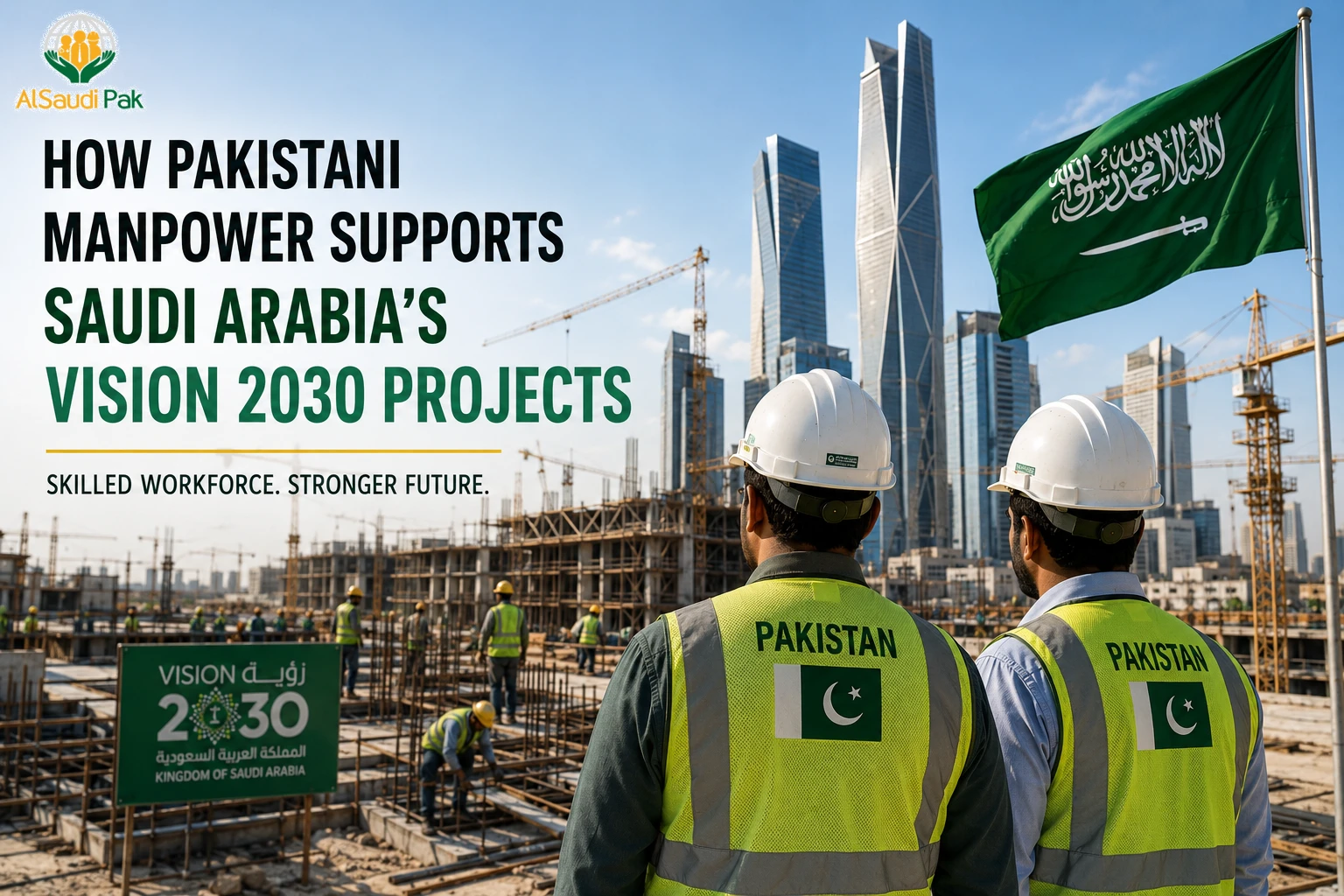
If you’ve been anywhere near the Saudi construction or industrial sector in the last few years, you already know the scale of what’s happening. NEOM, The Line, Qiddiya, ROSHN, the Red Sea Project, Diriyah Gate. These aren’t small developments. They’re some of the largest, most technically demanding projects on the planet, and they’re all part of one bigger plan Saudi Vision 2030.
For anyone running a contracting business, an EPC firm, or an HR department tied to Saudi operations, Vision 2030 has stopped being a talking point in government press releases. It’s now a real, operational challenge. Projects need to be staffed. Timelines are tight. Skilled labor is not sitting around waiting to be found. And this is exactly where Pakistan has quietly become one of the most important manpower sourcing countries for Saudi employers.
This isn’t a new story, but it’s one that’s growing fast. Let’s actually break down why.
Vision 2030 Needs More Than Money, It Needs People
It’s easy to think of Vision 2030 as a financial or policy shift. Diversifying away from oil, building new cities, growing tourism, expanding the private sector. All true. But every single one of those goals depends on physical labor and technical skill at a scale most countries simply can’t produce fast enough on their own.
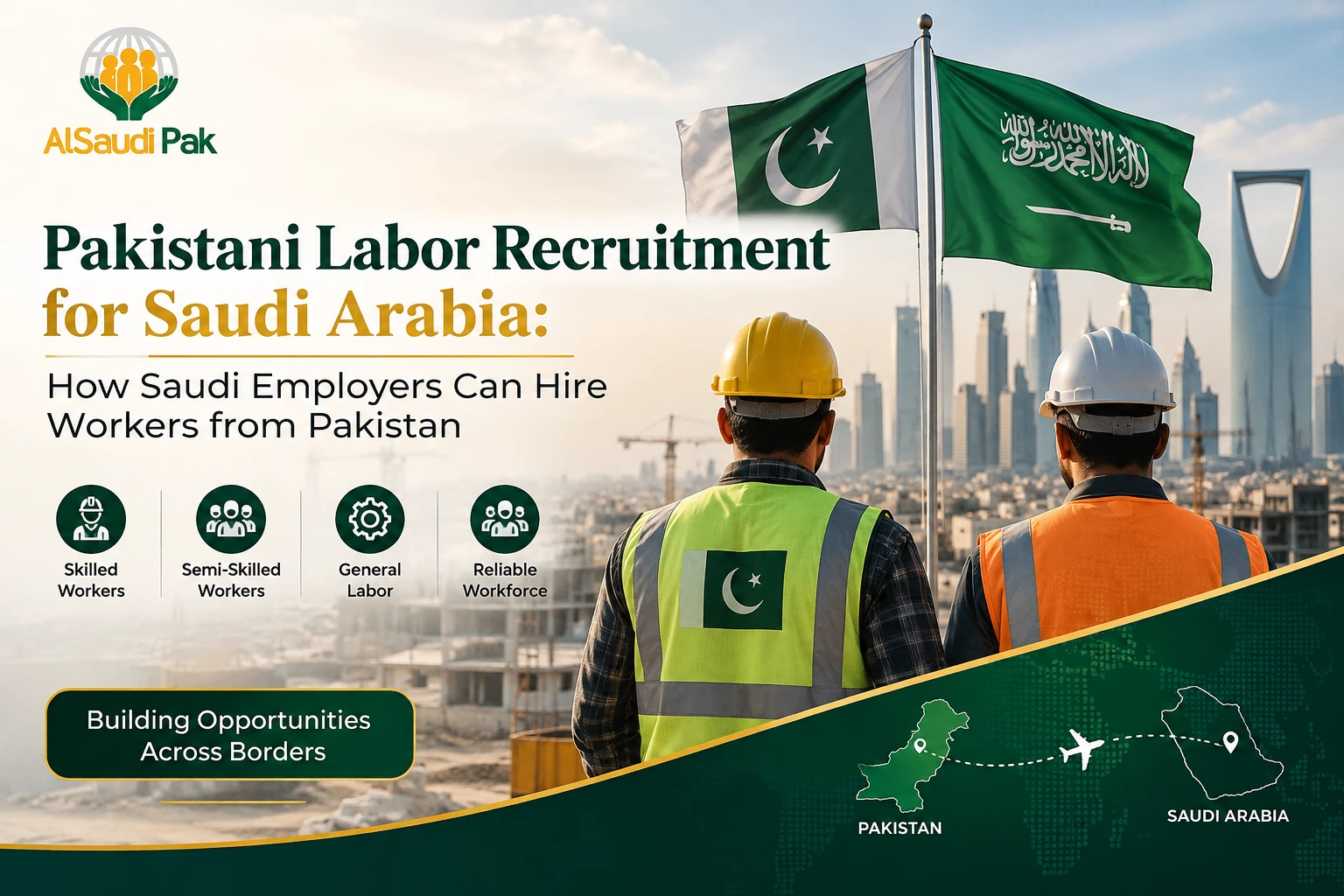
Saudi Arabia’s local workforce, while growing thanks to Saudization initiatives, still can’t fill the volume of technical and semi-skilled roles that giga-projects demand all at once. Steel fixers, welders, HVAC technicians, heavy equipment operators, site supervisors, electricians. Multiply that across dozens of simultaneous megaprojects and you get a labor gap that has to be filled internationally.
That’s the opening Pakistan has stepped into, and honestly, it’s not by accident. It’s been building for decades.
Why Pakistani Workers Keep Getting Chosen for Gulf Projects
Ask any Saudi contractor who’s worked with Pakistani labor for more than a few years, and they’ll usually give you similar reasons. It’s not just about cost, although that matters too. It comes down to a mix of practical factors that make onboarding and project execution smoother.
A workforce that’s already trained for this kind of work: Pakistan has technical training institutes and vocational programs that specifically prepare workers for Gulf-standard construction and industrial environments. This isn’t workers learning on the job in Saudi Arabia. Many arrive already familiar with the codes, safety standards, and site expectations used across the region.
Decades of Gulf work experience baked into the culture: Pakistani labor migration to Saudi Arabia and the wider Gulf isn’t a recent trend. Families have been sending workers to the region since the 1970s oil boom. That history means there’s an entire ecosystem, from training centers to recruitment offices to community support networks, built around making this transition work.
Cultural and religious familiarity that actually reduces friction: Shared religious practices, general comfort with Arabic workplace terms, and familiarity with Gulf social norms mean less adjustment time on-site. That might sound like a small thing, but on a project running 24/7 shifts with strict deadlines, it adds up.
A cost structure that still makes sense for large-scale hiring: Pakistan continues to offer a strong balance between skill level and overall mobilization cost, which matters enormously when a contractor needs to staff hundreds of positions without blowing the project budget.
Put those together and it’s not hard to see why Pakistani manpower has become a default choice rather than a backup option for many Saudi employers.
Where Pakistani Workers Are Actually Making a Difference
It helps to look at specific sectors rather than talk in generalities, because Vision 2030 isn’t one industry. It’s several running in parallel.
Construction and Infrastructure
This is the biggest one by far. Giga-projects like NEOM and Diriyah Gate need masons, formwork carpenters, steel fixers, and general labor in numbers that are hard to overstate. Pakistan has traditionally been one of the top sourcing countries for exactly these trades, and that pipeline hasn’t slowed down.
Oil, Gas, and Petrochemicals
Saudi Aramco’s ongoing expansion and downstream petrochemical projects still rely on certified welders, pipefitters, riggers, and scaffolders. Pakistani technical institutes have built a solid, recognizable reputation in these trades over the years, which makes hiring from Pakistan a lower-risk decision for project managers who can’t afford quality issues on pressure-critical work.
Healthcare and Hospitality
Vision 2030’s push into tourism and quality-of-life projects, think Qiddiya, the Red Sea giga-project, and the broader hospitality expansion, has created serious demand for nurses, hotel staff, and facility management teams. Pakistani professionals in these fields have been filling a growing share of these roles, particularly as hospitals and hospitality groups scale up staffing ahead of project launches.
Logistics and Manufacturing
As Saudi Arabia positions itself as a regional logistics hub connecting Asia, Africa, and Europe, warehouse supervisors, forklift operators, and industrial technicians are in demand too. This is a newer area of growth, but Pakistani manpower agencies have been quick to adapt their offerings to include these roles as Vision 2030 priorities shift toward trade and manufacturing.
The Real Bottleneck Isn’t Availability, It’s Sourcing
Here’s the part most people miss when they talk about labor supply for Vision 2030. Pakistan has the workforce. That’s not really in question anymore. The actual challenge for Saudi employers is finding a recruitment partner who can deliver that workforce quickly, correctly, and without the headaches that come from bad documentation or mismatched skill sets.
Think about what’s actually at stake on a Vision 2030 timeline. A single delayed mobilization, whether it’s a visa rejection, a missing medical clearance, or workers who don’t actually match the trade certification on paper, can push back a project schedule by weeks. On a giga-project with hundreds of contractors and subcontractors involved, that kind of delay has a real financial cost, and it reflects badly on whoever signed off on the recruitment partner.
This is exactly why so many Saudi companies have started actively searching for the best Pakistan recruitment office rather than just going with whoever responds first to an inquiry. The difference between a mediocre agency and a genuinely reliable one shows up fast once workers are on the ground.
So what actually separates a strong recruitment partner from an average one? A few things tend to stand out.
Pre-vetted, trade-tested talent pools: A good agency doesn’t start searching for candidates after you sign the contract. They already have qualified, trade-tested workers ready to go across construction, oil and gas, healthcare, and hospitality.
Documentation that’s handled correctly the first time: Protector of Emigrants clearance, GAMCA medical fitness, visa stamping, these processes have to be done right, because errors here are what cause the delays contractors dread most.
The ability to mobilize at scale: If a project needs 300 workers on-site within six weeks, the recruitment office needs the infrastructure and network to actually deliver that, not just promise it.
Transparent compliance with Saudi labor regulations: Everything needs to align with MHRSD requirements and international labor standards. This protects both the employer and the workers, and it’s non-negotiable for any serious B2B relationship.
Support that continues after deployment: Contract renewals, replacements, repatriation, these issues come up eventually on almost every long-term project. A recruitment partner worth working with handles this without making it the client’s problem to chase down.
What to Actually Ask Before Signing With a Recruitment Agency
If you’re a contractor, EPC firm, or HR manager evaluating recruitment partners for Vision 2030 work, it’s worth going in with a short list of direct questions rather than relying on a sales pitch.
Does this agency have a real, verifiable track record with Gulf-based contractors, not just a handful of domestic placements they’re presenting as international experience? Can they show trade-tested certifications for candidates rather than just forwarding CVs and hoping for the best? What’s their realistic average time from candidate selection to visa stamping, and can they back that up with references? Do they have an active, licensed presence in both Pakistan and Saudi Arabia, or are they operating through a chain of subcontracted agents you’ll have no direct line to? And can they actually scale from tens of workers to hundreds without the vetting process falling apart under pressure?
Agencies that answer these clearly, with documentation and references to back it up, are the ones worth building a long-term relationship with. The ones that get vague or defensive when asked these questions are usually a warning sign, not a coincidence.
The Compliance Side Nobody Talks About Enough
There’s a part of this whole conversation that doesn’t get discussed as much as it should, and that’s the compliance and legal framework sitting underneath every one of these hires. Saudi Arabia has tightened labor regulations significantly over the past several years, partly to protect worker rights and partly to formalize a system that used to run on a lot of informal arrangements.
For B2B buyers, this matters more than it might seem at first glance. A recruitment office that cuts corners on documentation isn’t just risking a delay. It’s exposing the hiring company to potential fines, project shutdowns, or reputational damage if labor inspections turn up problems. Wage Protection System compliance, correct contract terms matching what workers were promised before departure, accurate Iqama processing once workers land, these aren’t optional extras. They’re the baseline of doing this properly.
The agencies that have built real staying power in this space, the ones Saudi contractors keep coming back to project after project, tend to be the ones who treat compliance as part of their core service rather than paperwork they rush through at the end. It’s one more reason the search for a genuinely dependable Pakistan recruitment office has become such a priority for procurement and HR teams handling Vision 2030 contracts.
A Quick Look at the Numbers
It’s worth putting some rough scale behind this, because numbers tend to make the picture a lot clearer than general statements. Pakistan has consistently ranked among the top labor-sending countries to Saudi Arabia for years, with hundreds of thousands of workers deployed annually across construction, oil and gas, healthcare, and services. Remittances sent back from Gulf-based Pakistani workers, Saudi Arabia included, make up a meaningful share of Pakistan’s total foreign remittance inflow, which tells you this isn’t a marginal labor corridor. It’s a well-established, high-volume pipeline that both countries have a real economic stake in keeping efficient.
That scale is precisely why sloppy recruitment practices cause so much damage when they happen. When you’re moving workers in the hundreds or thousands for a single project, small process failures multiply fast.
Conclusion
Saudi Vision 2030 is only as strong as the workforce behind it, and Pakistan has spent decades building exactly the kind of skilled, trained, and ready-to-deploy manpower these giga-projects need. The real difference between a smooth project timeline and a delayed one usually comes down to one thing: choosing the right recruitment partner. For any Saudi contractor or business planning its next phase of hiring, finding the best Pakistan recruitment office isn’t just a staffing decision, it’s a direct investment in keeping Vision 2030 commitments on track.
Ready to source verified, project-ready manpower from Pakistan? Get in touch with our team today